Our story.
From farm fields and mule wagons to Pickstone Oval and padel: the people, photographs and stories behind Groot Drak.
A legacy written in the land.
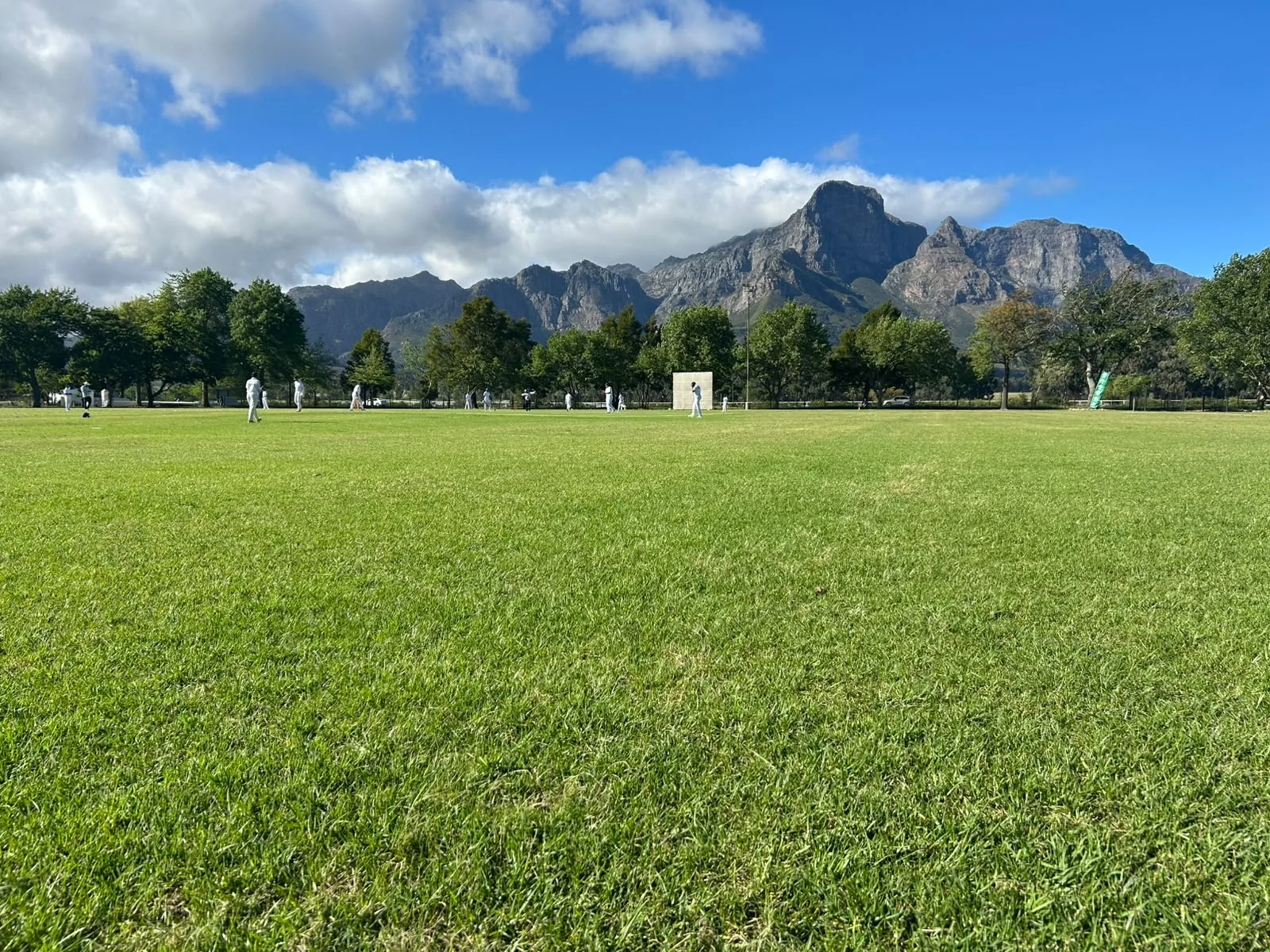
Walk onto Pickstone Oval and the club’s story is all around you: the oaks beside the boundary, the mountains beyond the outfield and the clubhouse waiting at the end of a game. Since 1895, sport has brought people here. The friendships have kept them coming back.
These pages draw on the club archive, members’ recollections, family records and accounts of visiting players. Among the voices woven into this history is Richard von Hoesslin, a club trustee, former President and Chairman, and trusted club historian. Associated with Groot Drak since 1966 and a member since 1978, Richard brings both his own experiences and stories handed down by earlier members.
Before there was an oval.
Groot Drakenstein Games Club traces its beginnings to 1895, when cricket and hockey players gathered on farm fields in the valley. The club’s written history recalls matches on Rhone and journeys to neighbouring towns by mule wagon. There was a game to be played long before there was a permanent ground to call home.
The team photograph from 1899 is one of the archive’s earliest glimpses of those years. Behind the formal pose is the beginning of a sporting community whose name would outlast many changes in the valley around it.
These were years of agricultural change, too. Vine disease and expanding fruit production reshaped the valley, its farms and its workers’ settlements. UCT’s archive dates the incorporation of Rhodes Fruit Farms to February 1902 and records H.E.V. Pickstone’s role in the company. The club’s beginnings belong within that wider landscape of farms and the people who worked on them.
Explore the valley’s historical records ↓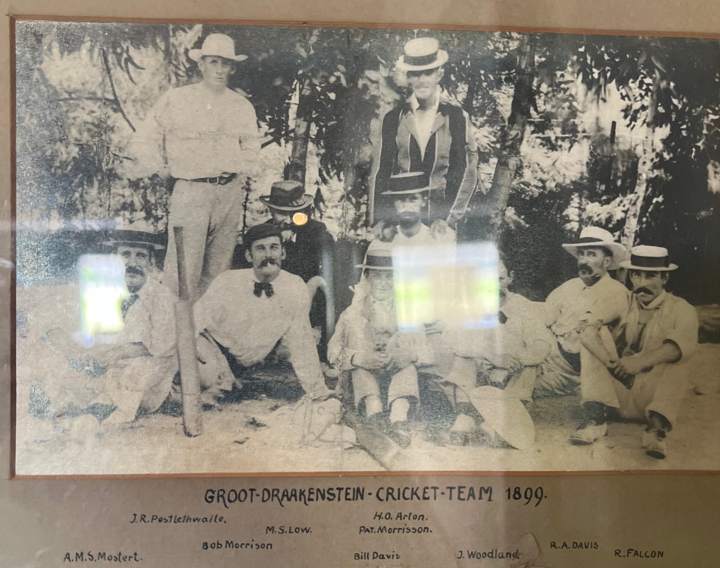
Ten acres. Ten shillings. A game of cricket.
In 1921, H.E.V. “Harry” Pickstone, a pioneer of the Cape’s fruit industry, offered the club ten acres at Delta for ten shillings a year. The lease ran for fifty years, with an option to renew, and carried a memorable condition: at least one game of cricket was to be played on the ground each year.
The land still had to become a ground. From October, members gave their Saturdays to clearing trees, levelling and ploughing. They became known as the Forest Span. The club history remembers Nicholas Gray, Tom Micklem and Jimmy Taylor among the people who helped with the work.
Those Saturday afternoons gave the club more than a playing field. Members were making a place where their neighbours could meet, their children could play and visiting teams could be welcomed. The Forest Span’s contribution belongs in the club’s story as surely as any innings or match result. In an account passed on by Ian Laurenson, Richard von Hoesslin also remembers a member named Ellis planting approximately three pin oaks near the entrance gates. The trees belong to the quieter history of members making the grounds their own.
A pioneering turf wicket
Pickstone Oval is widely recognised as home to South Africa’s oldest turf wicket. The club’s written history records the establishment of its match pitch on 26 April 1926, using horse-drawn equipment and planting Bradley grass in place of the coir matting then commonly used. It is a distinction that remains central to Groot Drak’s cricketing identity.
Discover Pickstone Oval →A small ground. A lasting place in cricket.
Groot Drak’s claim to South Africa’s first turf wicket has travelled far beyond the valley. Visiting schools, cricketers and the local tourism association describe it as the country’s oldest. The date recorded in the club’s own written history is 26 April 1926.
Newlands’ published history places a turf wicket there in 1927. That is consistent with Groot Drak’s earlier date. The distinction between laying a wicket, playing a local match and staging first-class or Test cricket matters when comparing the records.
The club-recorded date: 26 April 1926
The club’s written history records 26 April 1926 for the establishment of the turf match pitch. This is the date used throughout these pages. Earlier press recollections vary, including references to 1925, and are retained as recollections rather than substituted for the club’s precise record.
Newlands’ published venue history places its turf wicket in 1927. Kingsmead staged Natal against Border on turf in December 1926. These accounts concern different milestones: laying a wicket, playing on it and hosting first-class cricket. Groot Drak’s reputation as home to the country’s oldest turf wicket is widely repeated by visiting teams and the local tourism association.
Follow the sources below ↓The identity grew with the club.
Two blues and bottle green
A story passed from Ian Laurenson to Richard von Hoesslin traces the club’s colours to regular players from the Southern Peninsula in the 1940s. They asked why Groot Drak had no representative colours and, in this telling, brought a connection with Old Diocesans: dark blue, light blue and bottle green. The blues were associated with Oxford and Cambridge, and the green with the Springboks.
The precise adoption date remains to be established, but the story gives the colours a human origin: visiting cricketers becoming part of the club’s identity.
The bakkie that brought the beers
Before there was a club bar, players brought quart bottles of beer for after the match. John Taylor’s account, recorded by Richard, recalls the bottles being kept in the cold rooms at Rhodes Fruit Farms and collected shortly before play ended.
The delivery vehicle was a Vauxhall bakkie. When someone asked why the club had colours but no emblem, its griffin badge offered an answer. Ken Strable, remembered as “White Rhino”, was asked to investigate griffins and propose a club version. The familiar emblem’s origin is remembered in suitably sociable fashion: the vehicle that delivered the post-match beers.
A games club, from the beginning.
Cricket is central to the story, but it has never been the whole story. Hockey, tennis, swimming and the simple pleasure of spending time together have all helped shape the club.
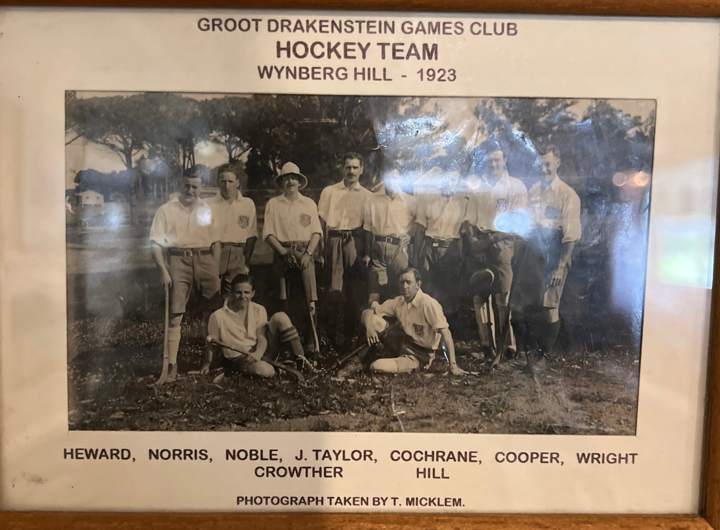
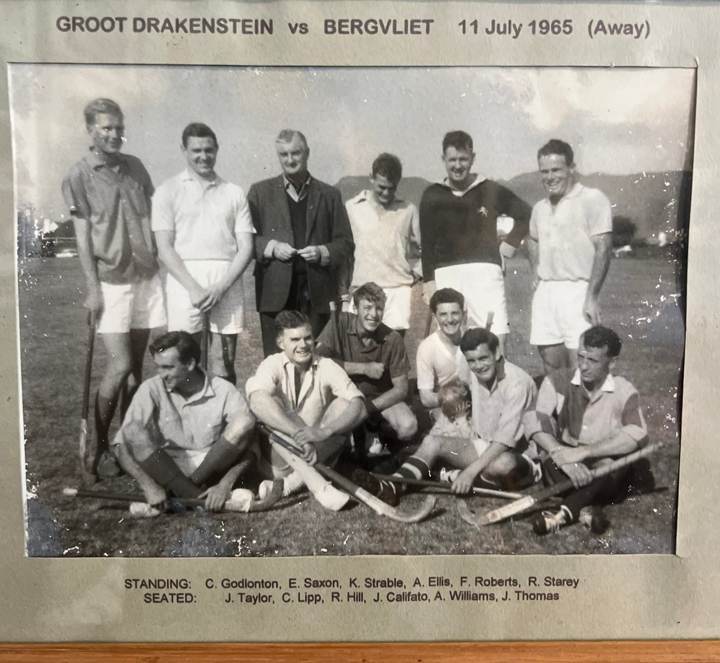
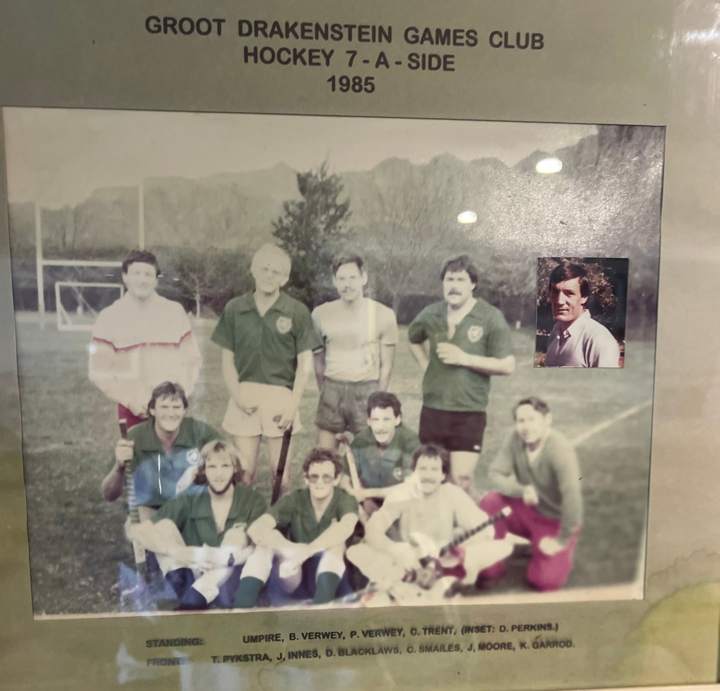
A tennis court was built in 1923, and work began on a golf course that did not endure. Hockey left a longer photographic trail: the archive preserves a team at Wynberg Hill in 1923, an away match at Bergvliet in July 1965 and a seven-a-side side in 1985. Those faces and familiar mountain backdrops belong beside the cricket photographs in the club’s sporting story.
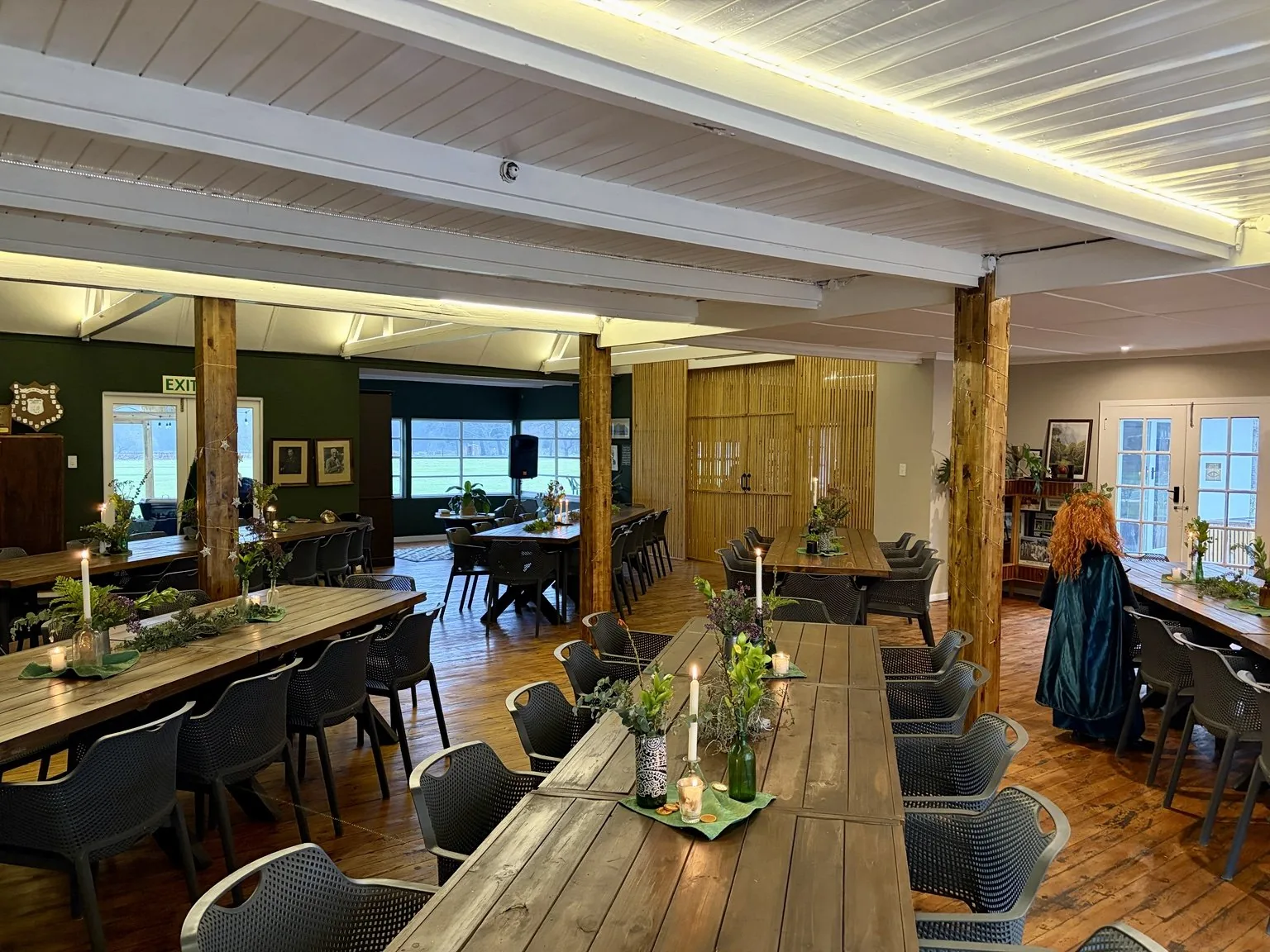
The timber Memorial Hall clubhouse opened in 1929. Extensions followed in 1959 and, much later, in 2007. Each generation adapted the building, making room for meals, celebrations and the conversations that carry on after the last ball. These are the moments a scorebook rarely captures: a story retold, a friendship renewed, a family staying a little longer.
The club received its liquor licence in 1962. Behind the formal milestone is a story John Taylor passed on to Richard von Hoesslin: John had persuaded Wendy Pickstone to agree to a bar, only for Wendy to be heard later regretting that she had given in. Work on the swimming pool and changing rooms followed in 1964–65, and the pool opened on 27 February 1965. A match, a swim and time around the clubhouse could now be part of the same visit.
The oak beside the pool is remembered as the Queen’s Tree. Trustee and longstanding member Richard von Hoesslin identifies its planter as Princess Elizabeth, later Queen Elizabeth II, during the royal visit in February 1947. Read the tree’s story and the surviving records ↓
Built by the people who used it
Richard remembers the club’s 90th year, 1985, when the still-basic bar was extended to the first pillar. Ten years later, the centenary brought a more ambitious round of work: an extended counter, washing room and cold room, a bar fireplace, a borehole and brick paving around the pool.
Piet Louw designed the gateposts, which Anglo American engineer Ralf Rosenstein built. Richard, then chairman, recalls laying the furthest cricket strip himself. These details put names to the practical work that shaped the club.
Making room for the next gathering
In 2000, Richard recalls George Northcote extending the entertainment area, including the television area and braai fireplace. Such changes gave members more room to stay after a game, meet friends and bring their families.
The clubhouse’s history is therefore a story of many contributions, from a lengthened bar to a newly laid strip: members improving a place they cared about.
The Queen’s Tree.
A royal visit, remembered locally
According to trustee and longstanding member Richard von Hoesslin, Princess Elizabeth planted the club’s oak during the royal visit in February 1947. His account recalls the King and his two daughters visiting Pniel to thank the community for its wartime support. He explains that the proposed tree planting was moved to the club amid the racial segregation policies of the time.
Richard shared this account with the club in October 2026 and expanded it in November, also crediting stories passed down by Ian Laurenson. It preserves local memory of an occasion that gave a familiar oak its enduring name. The surviving royal-tour sources establish the family’s movements through the valley, rather than independently confirming the planting itself.
The valley in the royal record
A Reuters report dated 20 February 1947 describes the royal family lunching at Bien Donné and visiting the valley’s fruit industry. A Royal Collection photograph also records the visit to Paarl that day. These place the royal family nearby during the month Richard recalls, although the precise day of the club’s planting remains unconfirmed.
The fire of 1991
Richard remembers the 1991 fire shortly after he became chairman. It swept through the myrtle hedge along the R45 boundary towards the clubhouse, scorching trees along its path and particularly the oak beside the pool. The tree survived and sent out new shoots. Some were selected to give it shape again: the familiar tree’s regrowth became another chapter in its life, tended by successive generations.
Visitors become part of the story.
The welcome to visiting teams has a long documentary trail. Phil Hartmann’s history of Claremont Cricket Club records a visit in 1937 and a country friendly in February 1941 that ended in a tie. Its references lead back to Cape Times reports, preserving a glimpse of cricket here before the modern touring era.
Spanspek, sixes and a swim
The March 1931 Paarl Post account preserved in the club archive brings Chapman’s MCC visit to life: a green oval against the mountains, a fast outfield and some mighty hitting by Wyatt. Chapman and Maurice Tate praised a ground maintained by the willing labour of local sportsmen. Fruit, lunch and the welcome from club members made the visit a valley occasion.
The account follows the visitors beyond the boundary: a dip in the Berg, Mrs Chapman enjoying a slice of spanspek in front of a tourist’s cine camera, and a stop at Koos Louw’s Stellenbosch farm on the way back to town. A later club cutting remembers Patsy Hendren missing his turn to bat because he was bathing in the river. Some visitors are remembered for more than their runs.
Taking the welcome overseas
The club’s written history is explicit: Groot Drak’s first overseas cricket tour went to England in 1974. Peter Hodes captained the side and Jack Manning managed the tour. After years of welcoming visiting teams to the valley, the club took its own cricket and friendships to English grounds.
Women’s Cricket History records another visit: Unicorns Women at Groot Drakenstein on 19 December 1983 ↗. Its four photographs show the visiting team and players making their way out to the wicket.
More than a fixture list
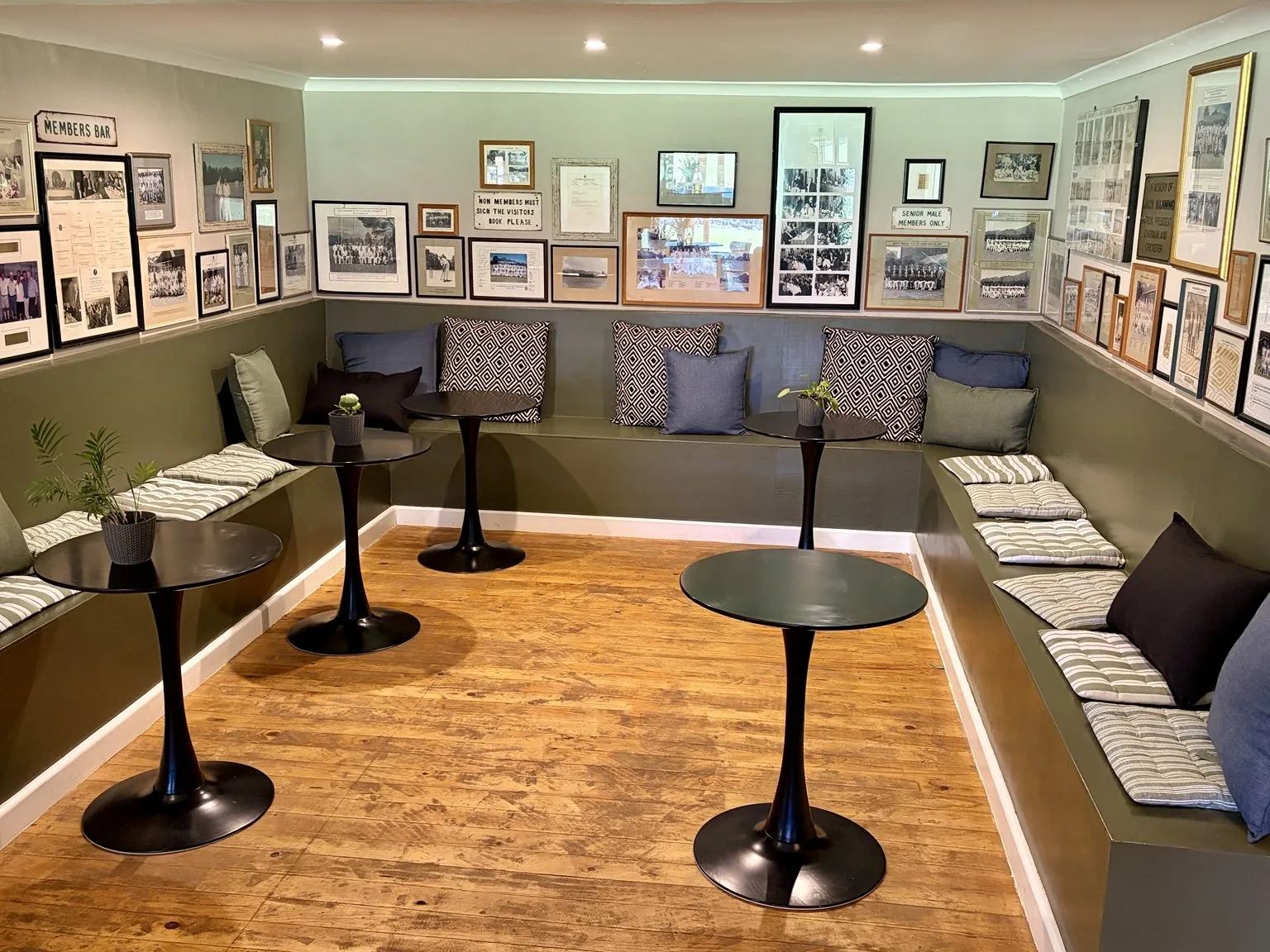
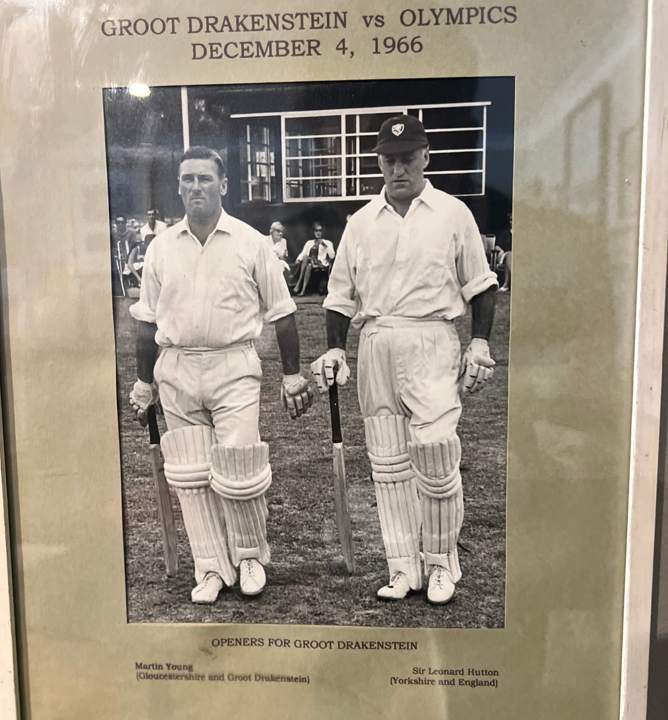
Celebrated players have left their mark, but the distinguished visitors sit alongside ordinary team photographs on the club’s walls. Both belong: those who came for a day and those who kept the game going season after season.
Famous faces, familiar pleasures.
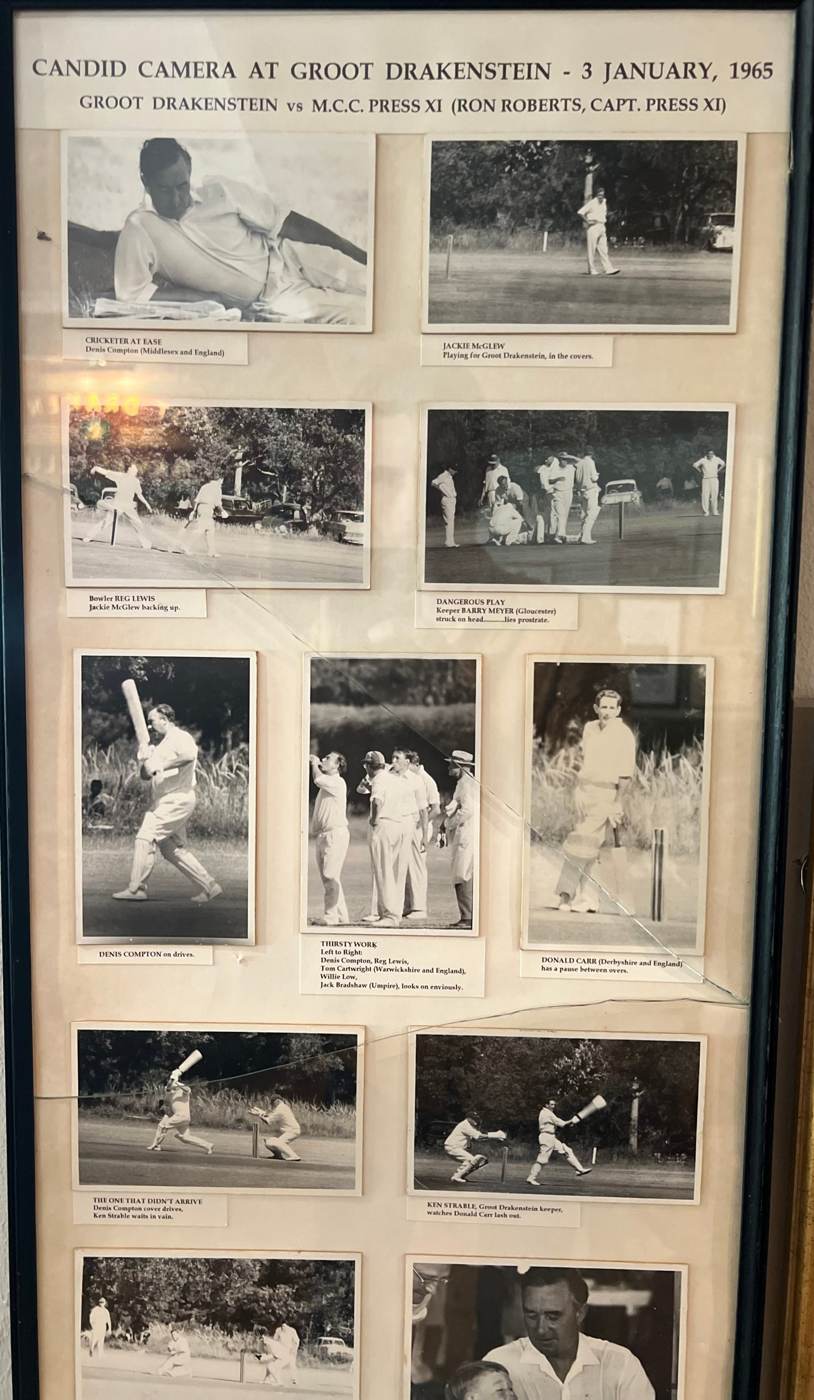
The display from 3 January 1965 records a match against the MCC Press XI, captained by Ron Roberts. Denis Compton is pictured driving and relaxing on the grass; Donald Carr pauses between overs, while Jackie McGlew fields in the covers for Groot Drakenstein.
Other captions identify Tom Cartwright, wicketkeepers Barry Meyer and Ken Strable, and umpire Jack Bradshaw. The camera caught the drinks break as carefully as the cricket: distinguished visitors sharing the unhurried pleasures of a day at the club.
The Springbok XI visits
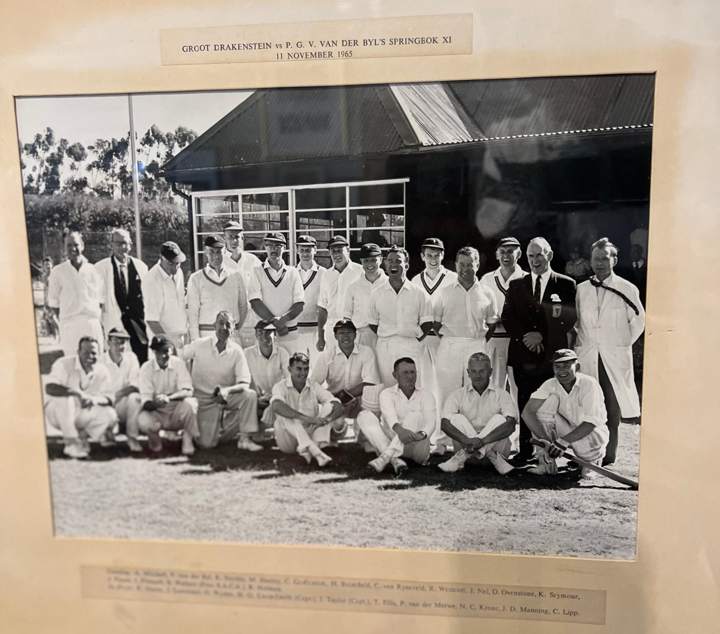
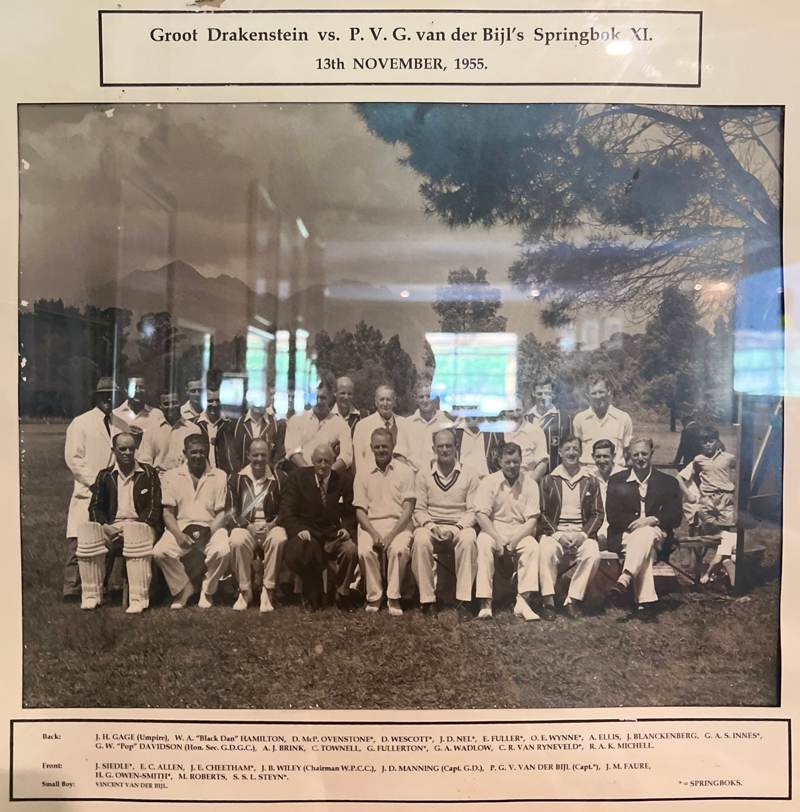
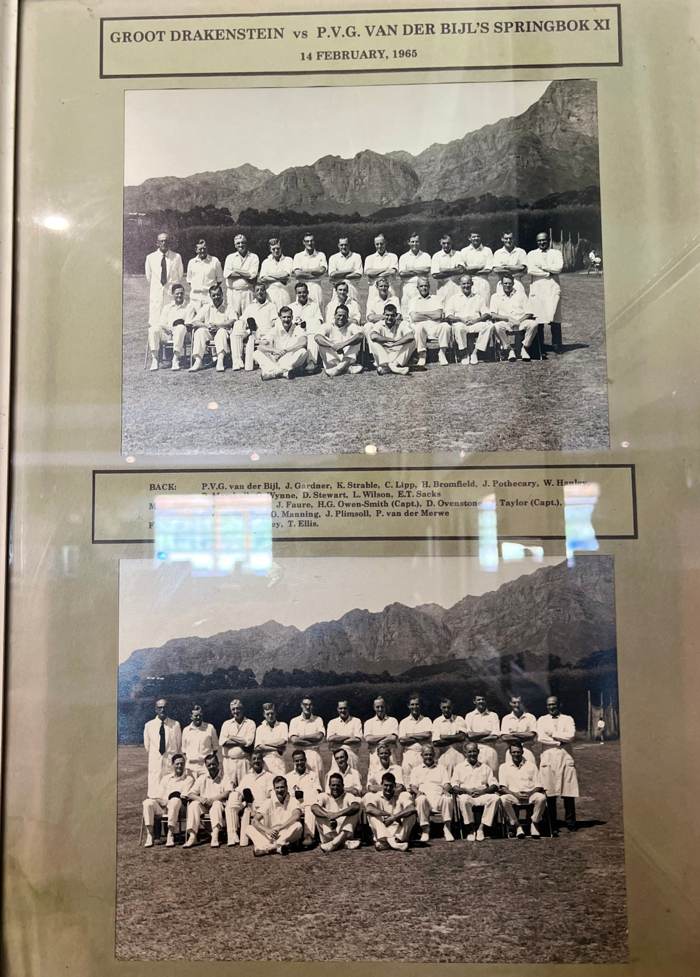
Team photographs dated 13 November 1955 and 14 February 1965 record matches against P.V.G. van der Bijl’s Springbok XI. In the 1955 caption, Jack Manning is the club captain and Eric Allen sits in the front row. The photographs put familiar club names alongside some of the country’s leading cricketers.
Remembering Eric Allen.
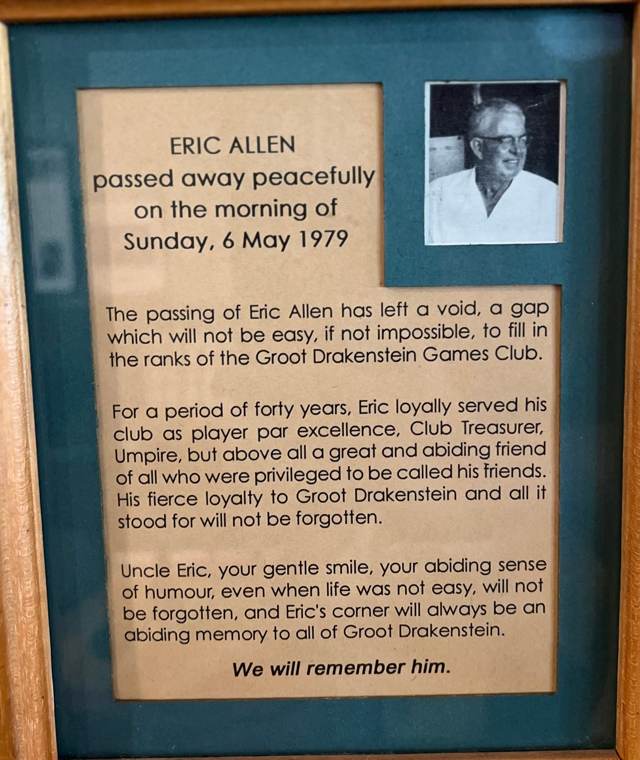
A club survives through the people who keep turning up. Eric Allen’s tribute offers a glimpse of what that devotion meant at Groot Drak.
After his death on 6 May 1979, the club remembered forty years of service as a player, treasurer and umpire. Above all, it remembered a friend: his gentle smile, his humour through difficult times and his loyalty to the club and its people.
The framed tribute promises that Eric’s corner would remain part of the club’s memory. Preserving it here gives a new generation a name and a face behind that familiar place.
From the memorial displayed in the clubhouse, preserved in the club archive.
Remembering Alfie Cupido.
Alfred “Alfie” Cupido is remembered by Richard von Hoesslin as a much-loved captain who led Groot Drak for many years. His place in the club’s story is inseparable from the people who played alongside him.
Richard recalls a home match against Western Province Cricket Club in which Alfie and a younger player were building a productive partnership. After a drinks break, Alfie collapsed while returning to the wicket. Despite the presence of two medically trained players, he could not be revived.
For those who remember him, there was consolation in the thought that he had been doing what he loved, in the place he loved. The account is preserved here in Richard’s recollection, without an unconfirmed match date.
Running all the way to victory
Another partnership lives in Richard’s memory for happier reasons. Angus Simmers and David von Hoesslin opened in pursuit of the opposition’s total and ran between the wickets until both were thoroughly out of breath. They passed the target without either losing his wicket. It was a partnership to remember, whether or not a scorebook can establish its place among the club’s records.
A catch worth a trophy
At a six-a-side tournament, David was fielding at deep mid-on when a batter sent the ball high into the air. Richard remembers him racing in, diving with an outstretched arm and taking it one-handed as he reached the pitch. David received the best fielder’s trophy.
Making room for the next player.
The Bishops connection
The friendship with Bishops Preparatory School dates to around 1949. Writing in 2026, Steven Riches traces the contribution of Jack Manning — cricketer, groundsman, captain, chairman, president and patron — and the later involvement of Richard von Hoesslin. The fixture has made room for successive generations of boys, teachers, parents and local players.
Its format has changed: afternoon cricket became a December morning game and later a pre-season fixture. Experienced club players, father-and-son combinations and a local boys’ XI have all taken the field. A College side joined the 1999 anniversary celebrations; the Prep staff’s Stags have continued the friendship too. The braai, swim and gathering on the pitch after play remain part of what makes a visit memorable.
Read Steven Riches’s account ↗Cricket across the valley
In 2018, the Franschhoek Tatler reported that the schools programme had involved more than 2,000 learners from 11 schools over twelve years. That season’s final went to Pniel Primary by a single wicket against Bridge House Prep.
Bridge House’s own 2024 coverage records its later participation in the GDGC T20 League. Together, these accounts show how the club’s cricketing story reaches beyond one ground and into the lives of young players across the valley.
Junior cricket today →A shorter game with a long history
Six-a-side cricket was introduced in 1961, with Bob Holman and Geoff Wadlow credited in the club history. It became an enduring tradition. A report on the John Faure Six-a-Side in February 2020 records eight teams taking part, with Maties beating Durbanville in the final.
Read the 2020 tournament report ↗Six-a-side stories passed down
Richard records John Faure’s recollection of English touring reserves, managers and supporters forming a team to play at Groot Drak on a Sunday during a Newlands Test. In that telling, their enthusiasm travelled home with them, becoming part of the club’s tradition about its contribution to short-format cricket.
The story includes a claim that the tournament influenced English one-day cricket and the treatment of wides. That is an attributed club tradition, rather than an established account of the origins of the format or its laws. John’s recollection dates the tournament’s beginnings to 1955; the club’s written chronology uses 1961. Both accounts are retained while the early records are explored.
Beyond the boundary trees
Richard remembers a Western Province player he identifies as Bruce hitting a six over the trees beside the R45 and into a further row of the neighbouring canning-peach orchard. Adrian Kuiper sent another over a dead black wattle beside the north-eastern boundary road, landing close to the Delta Crest fence.
The peach trees and black wattle have since gone. The shots remain in the memories of those who saw them.
An international meeting place.
On 13 March 2023, Groot Drakenstein hosted England and South Africa in the Over-50 World Cup. England won by three wickets, adding an international veterans’ fixture to the ground’s record.
Oxford University’s account of its 2024 South African tour records a match here too. Oxford made 343 before dismissing the hosts for 175. The university’s report brings the visiting team’s own perspective to the story of cricket at the Oval.
Results are only one part of a tour. Writing in 2024, Alex de Bruin describes a Danish team from Copenhagen and the meal and speeches that followed their visit. Moose Cricket Club’s 2017 diary also remembers the welcome and a braai at Groot Drak. These personal accounts capture what visitors take away alongside the score.
Read the match reports and touring accounts ↓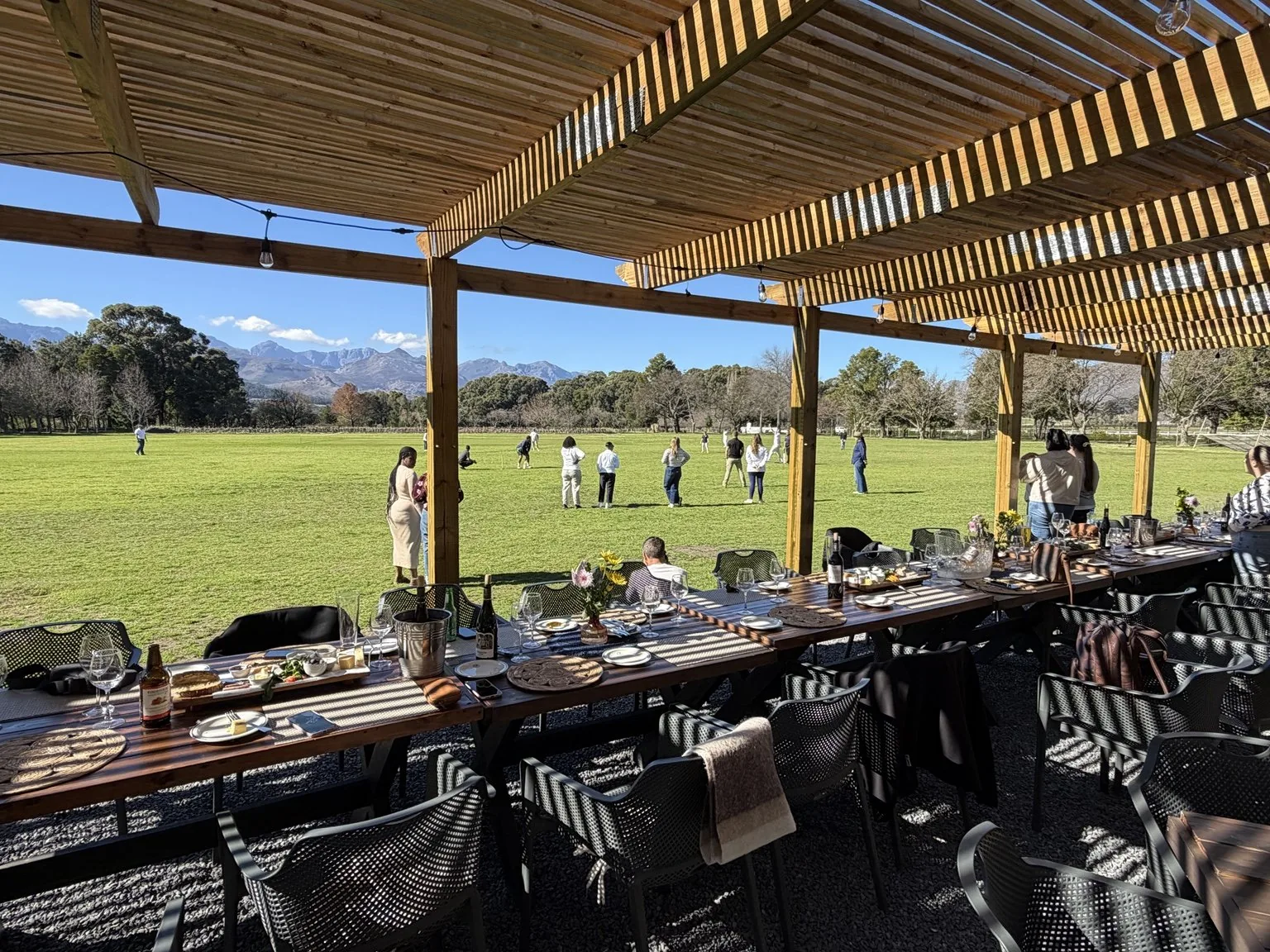
The welcome travels far.
Season after season, touring teams bring new friendships to the Oval. Their diaries, letters and recollections carry a little of Groot Drak home with them.
Remembered by a writer
J.C. Kannemeyer’s biography of Uys Krige recalls the writer’s student cricket visits to the fruit farmers of Groot Drakenstein: cricket, tea in the pavilion and the warmth of the welcome. The passage draws on Krige’s own recollections in Sout van die aarde. It is a literary glimpse of the social life around the game.
Plum Warner and the Pickstones
Cricket writer and former England captain Pelham “Plum” Warner remembered a lunch with the Pickstones at neighbouring Lekkerwijn during a South African holiday. His memoir, Long Innings, is cited in André Odendaal’s account of cricket and the Cape landscape. It connects a major cricketing figure with the family and the valley; the account does not establish an innings at the club.
A century remembered
Writing in the Sussex Martlets’ 2013 newsletter, David Gibbs recalled the side’s 1972 visit to Groot Drakenstein and a century by Mike Griffith. His recollection adds a visiting player’s voice to the years before Groot Drak’s own first overseas tour to England in 1974.
Friendships renewed
The Ulster Grasshoppers’ history records a return to Groot Drakenstein during their 2003 South African tour. Incogniti’s 2018 account and the Royal Artillery’s report of its 2023 tour add further chapters. Together with the women’s teams, schools and other visiting sides in this archive, they show how many different cricketing communities have found a welcome here.
Veterans and the next generation
The Oval also hosted the inaugural Boland Veterans T20 Franchise League final on 17 March 2023. Paarl Heat beat Helderberg Vikings by three runs, according to the contemporary local report. At the other end of the age range, Bridge House’s February 2024 account records its under-12 side playing PC Pietersen in the GDGC T20 League. The club’s cricketing life continues across generations.
Friendships packed alongside the cricket kit.
The welcome extended to visitors at Pickstone Oval travelled with Groot Drak’s own teams. Richard’s Golden Oldies memories bring together cricket, improvised solutions and the stories that outlast a scorecard.
1998 · An Argentinian for the tournament
Richard dates the club’s first Golden Oldies participation to the Western Cape tournament in 1998. Lewis Silberbauer was lent to the Argentinian team and became, in the affectionate language of the tour, an “Argie”.
2000 · Just in time for Rotorua
The New Zealand departure was almost missing Lewis. Richard recalls his wife Caroline phoning the team at the airport to ask whether they could hold the plane while he waited for medical clearance to travel and play. He arrived in time, giving the Rotorua trip a memorable beginning.
2002 · Gerry and the Pacemaker
In Queensland, the entertainment continued after the cricket. Lewis and Gerry Tucker joined forces for a singing performance so successful that they became known as “Gerry and the Pacemaker”.
2004 · A farmer’s solution in Vancouver
Arriving early for their first game in Canada, the players found an unmowed field. Dave Rennie, one of the farmers in the side, found a tractor and mower with the key still in the tractor and got to work.
A manager interrupted to warn that he had not obtained permission. Richard remembers Dave finishing the mowing and parking the tractor. Nothing more was heard: the field was ready, and another touring story had been made.
2006 · Sri Lankan adventures
Rory McMillan’s secretary had to remind him that he was supposed to be catching a plane. Richard’s account remembers a hurried departure and a traffic officer who, on hearing about the cricket tour, wished him luck in making South Africa proud.
Near Kandy, the group lost track of Lewis during a botanical-gardens visit and found him absorbed in the arboretum, reflecting his professional interest in trees. At an old hotel beside Colombo’s harbour, Richard and Lewis shared a room and a double bed; Richard recalls Lewis discovering his roommate’s nocturnal “boxing skills”. Such moments, as much as the matches, made the tour their own.
Tour dates and incidents in this section follow Richard von Hoesslin’s personal recollections, supplied in November 2026.
The next chapter is already being played.
In 1977, Wendy Pickstone gifted the land to the club, with the transfer formally recorded as a sale for the nominal sum of R1. Her generosity secured a permanent home for the club and remains an enduring part of its legacy. The 1995 centenary brought improvements to the bar, entrance and field, including gates dedicated to Jack Manning. In 1999, a ceremony on the pitch formally named the field Pickstone Oval, recognising the family whose offer had given the club its home.
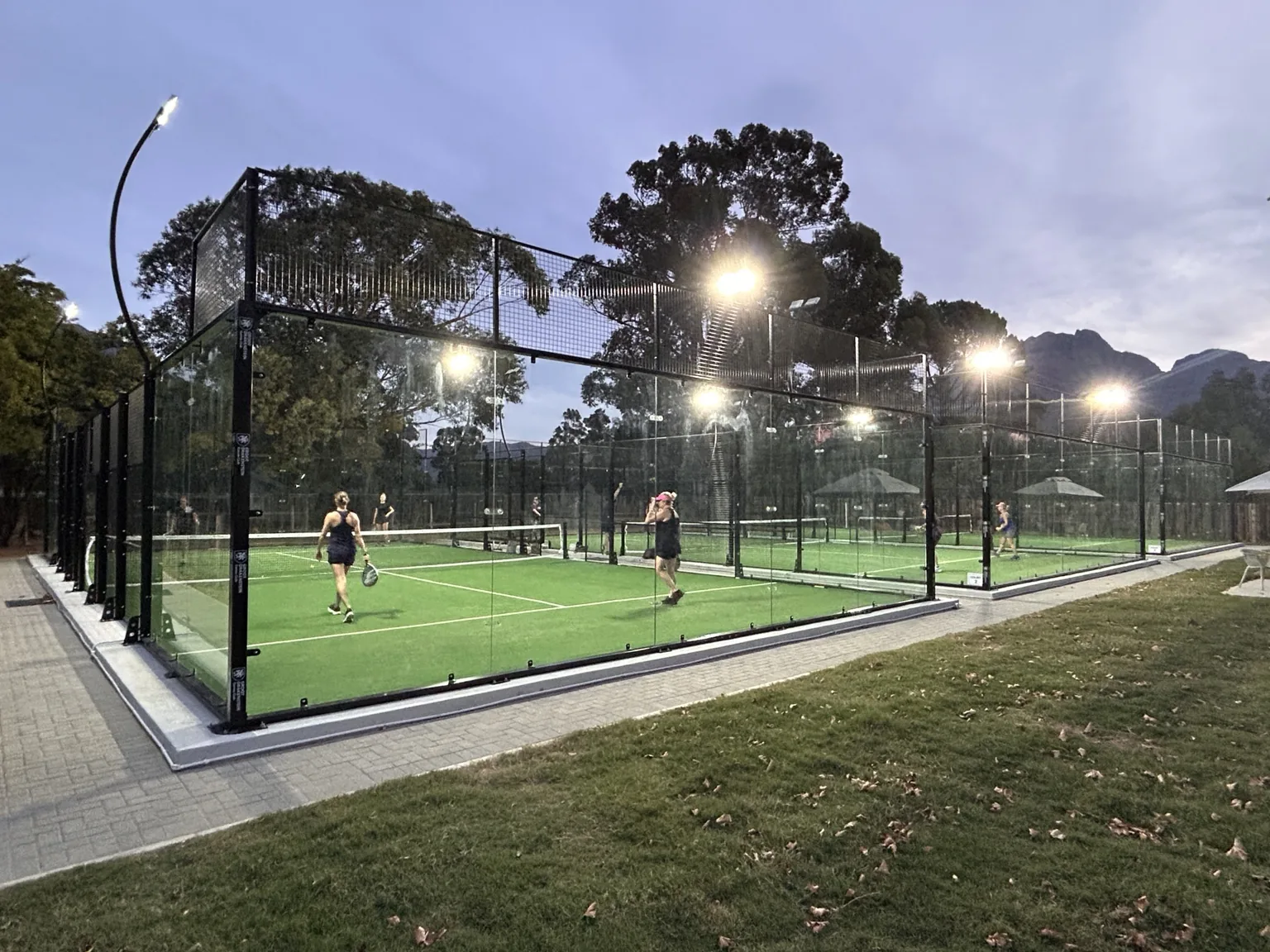
Three padel courts opened in January 2026, adding a new sport to a club that began with cricket and hockey. Players discovering the courts now share the grounds with cricketers, young families and familiar faces returning to the clubhouse. The games evolve; the pleasure of spending a day here carries on.
The work of maintaining the grounds and organising the games continues, often quietly, behind each visit. On the veranda, around the boundary and after a match, people make their own memories of Groot Drak. Today’s photographs will one day sit alongside those of the players who came before.
Milestones along the way.
- 1895Cricket and hockey bring players together on the valley’s farm fields.
- 1921The lease at Delta gives the club a home. The Forest Span begins work on the ground.
- 1923A tennis court is built; the hockey team is photographed at Wynberg Hill.
- 26 Apr 1926The club’s written history dates the establishment of its turf match pitch to this day. Read the source note.
- 1929The Memorial Hall clubhouse opens.
- 1931Press accounts in the club collection recall Chapman’s MCC visit, cricket and valley hospitality.
- 1937 & 1941Claremont’s history records visits, including the tied friendly in February 1941.
- Feb 1947Richard von Hoesslin recalls Princess Elizabeth planting the oak now known as the Queen’s Tree. Read the attributed account.
- c. 1949The cricketing friendship with Bishops Prep begins.
- 1961–1965Six-a-side cricket, a liquor licence and the new swimming pool add to club life.
- 1955 & 1965Archive photographs record Springbok XI visits, the MCC Press XI match and hockey at Bergvliet.
- 1966Young and Hutton appear together in the club’s cricket archive.
- 1974Groot Drak’s first overseas cricket tour goes to England, captained by Peter Hodes and managed by Jack Manning.
- 1977Wendy Pickstone gifts the grounds to the club; the transfer is formally recorded as a sale for the nominal sum of R1.
- 1979The club remembers Eric Allen after forty years of service and friendship.
- 1983 & 1985Photographs preserve a Unicorns Women visit and a club hockey seven-a-side team.
- 1985Richard von Hoesslin recalls the bar being extended to the first pillar during the club’s 90th year.
- 1991A fire beside the pool damages the royal oak, according to Richard von Hoesslin’s recollection.
- 1995 & 1999The club celebrates its centenary; four years later, the field is formally named Pickstone Oval.
- 1998–2006Richard’s Golden Oldies accounts follow the club from the Western Cape to New Zealand, Australia, Canada and Sri Lanka.
- 2000George Northcote extends the entertainment area, according to Richard’s recollection.
- 2007Further clubhouse extensions serve a new generation of members.
- 2018Published coverage records the reach of the schools cricket programme.
- 2023 & 2024The Oval hosts an Over-50 World Cup match and a visit by Oxford University.
- 2026Three padel courts open in January.
The archive beyond this page.
The club’s written history, clubhouse photographs, family records and members’ recollections form the starting point. These selected publications add other voices and lead to further records. We distinguish dated documentary evidence from personal memories and traditions passed down through the club.
Richard von Hoesslin · A member’s experiences and stories handed down
Richard von Hoesslin is a club trustee, former President and Chairman, and trusted club historian. Associated with Groot Drak since 1966 and a member since 1978, he has also served as Treasurer, Secretary and Saturday cricket captain, and played cricket and field hockey.
His accounts, “GDGC Stories down the ages” (6 November 2026) and “GD Stories; my experiences” (7 November 2026), enrich the history above. The first credits Ian Laurenson, John Taylor and John Faure for stories handed down; the second records Richard’s own recollections. His original contributions are retained in the club’s private archive.
The accounts have been edited for clarity while retaining attribution and uncertainty. In particular, a reference to minute books around 1922 is a research lead, not a replacement for the club-recorded turf-wicket date of 26 April 1926. The early provision of the grounds by Harry Pickstone remains distinct from Wendy Pickstone’s gift in 1977, formally transferred for R1.
The Queen’s Tree and the royal visit
- Richard von Hoesslin · Recollection shared with the club, 22 October 2026The attributed source for Princess Elizabeth’s planting in February 1947, the Pniel connection and the fire of 1991. Private contact details are not published.
- Reuters / The Daily News · 21 February 1947, page 3 ↗Report datelined 20 February, describing the royal family’s valley visit and lunch at Bien Donné.
- Royal Collection Trust · RCIN 2704713 ↗Photograph catalogued as the royal visit to Paarl on 20 February 1947.
Visiting voices, touring friendships and valley connections
- J.C. Kannemeyer · Die goue seun (2002) ↗Pages 79–80 recall Uys Krige’s cricket visits; the note points to Sout van die aarde (1961), pages 109–110.
- André Odendaal · Cricket and representations of beauty ↗The chapter cites Warner’s Long Innings (1951), pages 132–135, for the Pickstone lunch; it does not establish a Groot Drak innings.
- The Martlet · 2013 newsletter ↗David Gibbs’s recollection of the 1972 visit and Mike Griffith’s century.
- Incogniti · South Africa tour, 2018 ↗The Groot Drakenstein account and scorecard describe the visitors batting first to avoid fielding in the heat.
- CricketEurope · Ulster Grasshoppers, 1980–2005 ↗A touring history that includes the 2003 return to Groot Drakenstein.
- The Gunner · January 2024 ↗Royal Artillery coverage of its 2023 South African cricket tour.
- DistrictMail & Helderberg Gazette · March 2023 ↗The Boland Veterans T20 final at Groot Drakenstein on 17 March 2023.
- Neil Palmer · The Gray family and the Bleskop memorial ↗A wider valley-history research lead connecting the Gray and Pickstone families. Its discussion of memorial names is not proof that all those commemorated were club members.
The turf-wicket chronology and the club archive
- The club-recorded date and context ↑The date used here is 26 April 1926, as recorded in the club’s written history. Earlier newspaper recollections are retained in the archive as supporting historical accounts with varying dates.
- Cricinfo · Newlands venue history ↗The 2003 venue guide places the laying of a Newlands turf wicket in 1927.
- Franschhoek Wine Valley · Groot Drakenstein Games Club ↗The tourism association describes Groot Drak as having the country’s oldest turf wicket. This supports its established reputation, rather than a precise construction date.
- Club archive · Clubhouse photographs and history ↑Five additional framed displays: the MCC Press XI in January 1965, Eric Allen’s memorial, Springbok XI photographs from 1955 and February 1965, and hockey at Bergvliet. Newspaper stories are attributed to the collection; their original editions have not all been independently inspected.
Early cricket, the valley and its archives
- Phil Hartmann · History of Claremont Cricket Club, Part 2 (PDF) ↗Printed pages 131 and 143 cover the 1937 visit and 1941 tie, citing the Cape Times of 3 December 1937 and 24 February 1941. Those newspaper references offer a route into the original reports.
- UCT Libraries · Rhodes Fruit Farms collection ↗Catalogue ZA UCT BC1555, covering 1898–1976. Its administrative history records the company’s formation and Pickstone’s role; related collections include the Alfred Appleyard Papers and Marian Robinson Papers.
- TopFruit · Harry Pickstone and the fruit industry ↗Identifies H.E.V. “Harry” Pickstone and describes his nursery work and role in the Cape’s fruit export industry.
- Antonia Malan · Stellenbosch historical framework, 2018 (PDF) ↗A wider history of the valley’s agriculture, settlements and people.
- Kanonkop · The cannon and arriving ships ↗The estate’s account of a signal for farmers bringing produce to port provides regional context alongside the club’s cricketing tradition.
- Cricinfo archive · England’s early tours of South Africa ↗Tour chronology places Stanyforth in 1927–28 and Chapman in 1930–31, useful background to the club’s MCC stories.
Schools, six-a-side and women’s cricket
- Steven Riches · Another chapter in this great cricketing friendship ↗Bishops OD Union, 10 September 2026: generations of school cricket and the people who sustained the connection.
- Bishops Prep · Newsletter, 25 September 2025 ↗A contemporary school account of the annual visit.
- Franschhoek Tatler · Cricket final goes down to the wire ↗Richard von Hoesslin’s 2018 report on the schools programme and a one-wicket final.
- Bridge House · A flurry of cricketing action, 2024 ↗The school’s report includes participation in the GDGC T20 League.
- Franschhoek Tatler · Six-a-side success, 2020 ↗A report on the John Faure tournament, with eight sides and a Maties victory.
- Women’s Cricket History · Unicorns Women at Groot Drakenstein ↗Four photographs dated 19 December 1983. Follow the gallery’s individual photographs for their archive captions.
World Cup cricket, touring teams and personal memories
- Club Cricket SA · Over-50 World Cup, 13 March 2023 ↗The completed match report records England’s three-wicket win over South Africa at Groot Drakenstein.
- Oxford University Cricket Club · 2023–24 report (PDF) ↗The South African tour account on PDF page 7 includes the Groot Drakenstein match.
- Alex de Bruin · Cricket at Groot Drakenstein, 2024 ↗A first-person account of a Danish touring visit, its cricket and its hospitality.
- Moose Cricket Club · 2017 tour diary ↗A visiting team’s memories of its day at Groot Drak.
- SOA Cricket Club · 2019 review and Philip Alston tribute ↗Richard Pineo recalls Alston’s 1997 farewell at Groot Drak and his return to cricket.
Club traditions are introduced as memories passed down by members. They belong alongside the dated records, and the archive can keep growing as more photographs, scorebooks and recollections come to light.
The next chapter includes you.
Come for a game, bring your family for an afternoon or discover a new sport. Every player who returns and every newcomer who feels at home adds something to Groot Drak. The next chapter will be made in the same way as the first: by people choosing to take part.
Become part of Groot Drak